Pascal's law
Pascal's law states that when there is an increase in pressure at any point in a confined fluid, there is an equal increase at every other
point in the container.
Example
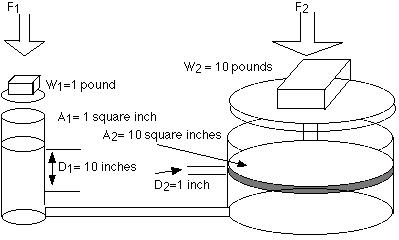
Applied to a more complex system below, such as a hydraulic car lift, Pascal's law allows forces to be multiplied. The
cylinder on the left shows a cross-section area of 1 square inch, while the cylinder on the right shows a cross-section area of
10 square inches. The cylinder on the left has a weight (force) on 1 pound acting downward on the piston, which lowers the
fluid 10 inches. As a result of this force, the piston on the right lifts a 10 pound weight a distance of 1 inch.
The 1 pound load on the 1 square inch area causes an increase in pressure on the fluid in the system. This pressure is
distributed equally throughout and acts on every square inch of the 10 square inch area of the large piston. As a result, the
larger piston lifts up a 10 pound weight. The larger the cross-section area of the second piston, the larger the mechanical
advantage, and the more weight it lifts
Picture
Reference
Pascal's Principle and Hydraulics
